
AI Native Demand Sensing Software
Sense and Respond to Real-Time Market Signals Using Deep Learning
Harness AI-driven ability to sense and respond at a granular level, optimizing revenue and margin capture by leveraging external market signals, retail POS data, and competitive insights.
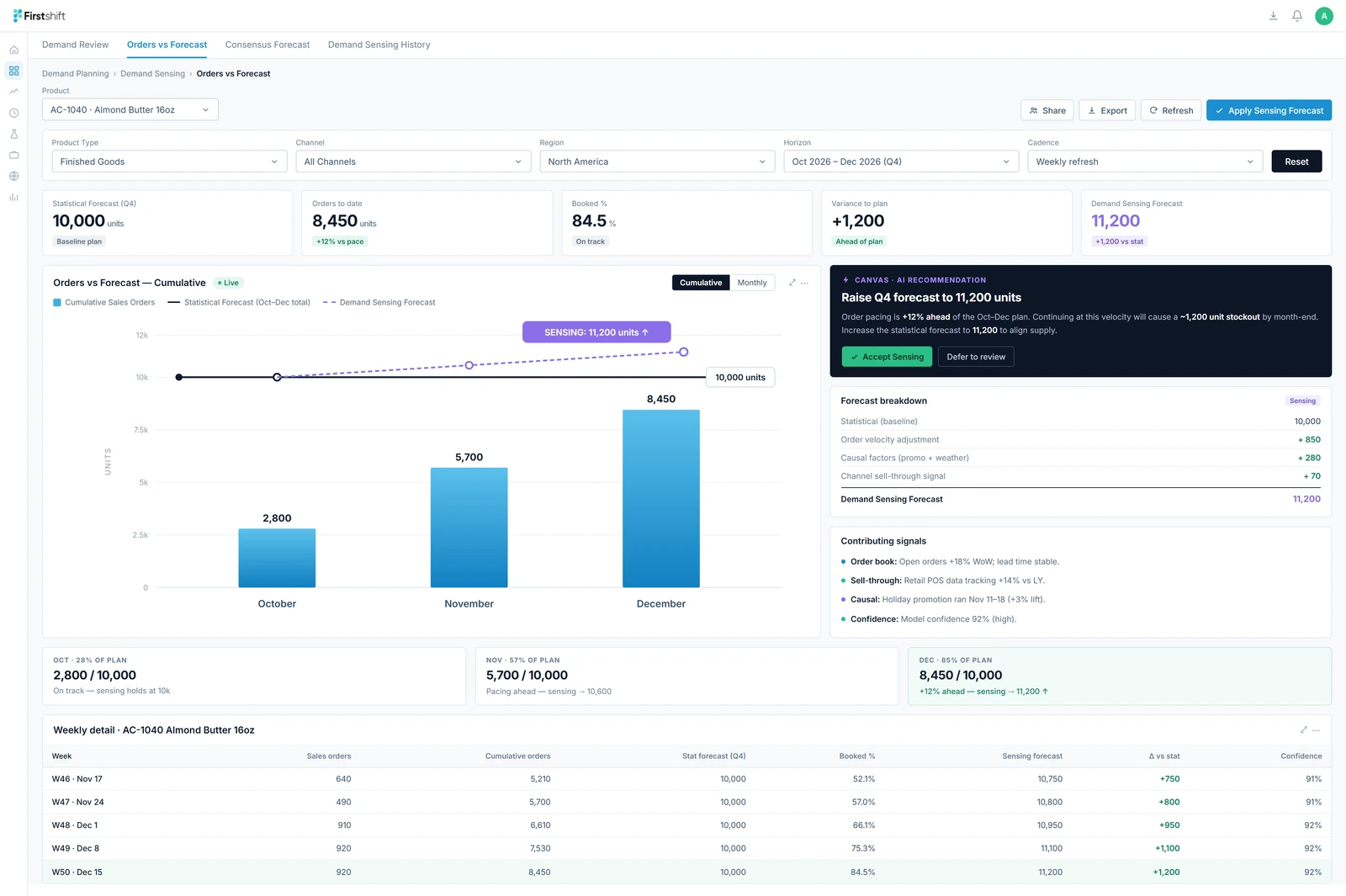
Demand sensing software uses deep learning models and real-time market signals (including retail POS data, DC-level inventory, competitive pricing, and promotional calendars) to predict short-term demand shifts days or weeks before traditional forecasting systems detect them. AI-native demand sensing platforms like Firstshift improve near-term forecast accuracy by up to 20%, enabling manufacturers to position inventory proactively and capture 3–10% more revenue.
Demand Sensing
AI-Driven Sense & Respond
Deep Learning models predict short-term demand (orders) to improve near-term forecast accuracy by up to 20%, enabling proactive inventory positioning.
External Signal Integration
Leverage retail POS data, DC-level orders and inventory, pricing and margins, and competitive insights to sense demand shifts before they hit your supply chain.
Advanced Insights
Granular analysis of demand patterns at the SKU-location level, identifying trends and anomalies that traditional planning systems miss entirely.
Scenario Analysis
Model different inventory and postponement strategies to optimize service levels and minimize chargebacks, write-offs, and lost revenue opportunities.
Why Short-Term Demand Signals Get Lost
What is the difference between demand sensing and demand forecasting?
Demand forecasting predicts medium to long-term demand (typically weeks to months ahead) using historical sales data and statistical models. Demand sensing operates on a much shorter horizon: days to two weeks. It does this by ingesting real-time market signals (retailer POS scans, DC order patterns, competitive pricing movements, weather events) that traditional forecasting systems do not process. The result is a highly accurate short-term demand signal that allows manufacturers to reposition inventory, adjust replenishment orders, and capture demand opportunities before competitors or legacy planning systems even detect the shift.
Why do short-term forecasts fail to capture sudden demand shifts?
Traditional short-term forecasts extrapolate from historical data using fixed statistical models that update weekly or monthly. When a viral social media moment drives unexpected demand for a product, when a competitor goes out of stock and demand shifts to your SKU, or when a regional weather event spikes demand for seasonal products, these signals appear in retailer POS data hours after the fact, but standard forecasting systems do not ingest this data in real time. By the time the weekly forecast cycle updates, the demand window has already opened and closed. AI demand sensing software closes this lag by monitoring external signals continuously and adjusting near-term forecasts within hours.
How do chargebacks and lost revenue result from poor short-term demand visibility?
When manufacturers cannot sense near-term demand shifts accurately, two costly outcomes occur simultaneously: stockouts on in-demand SKUs lead to retailer chargebacks and lost revenue, while excess inventory of slow-moving variants results in write-offs and markdown costs. Retailers increasingly hold manufacturers financially accountable for service level failures through chargeback penalties. Firstshift demand sensing improves near-term forecast accuracy by 20%, enabling proactive inventory positioning that reduces both stockout-driven chargebacks and excess inventory write-offs, capturing 3–10% more revenue in the process.
Why is retail POS data so difficult to integrate into demand planning?
Retailer POS data arrives in multiple formats from dozens of trading partners (weekly sell-through reports, daily EDI feeds, syndicated data services), each with different schemas, data quality standards, and latency. Most manufacturers receive this data but lack the infrastructure to cleanse, harmonise, and model it at the SKU-location-week level required for actionable demand signals. Firstshift's External Signal Integration capability handles this data pipeline automatically, transforming raw retailer POS, DC inventory, and competitive pricing data into clean demand signals that feed the deep learning models within hours of receipt.
Make the Smart Shift
Firstshift is an AI-native demand sensing platform built for food and beverage manufacturers, consumer packaged goods companies, and distributors. Unlike traditional demand planning tools that update forecasts weekly from internal sales history, Firstshift ingests real-time retail POS data, DC-level order signals, competitive pricing, and promotional calendars to generate a continuously updated near-term demand picture, improving short-term forecast accuracy by 20% and enabling manufacturers to capture 3–10% more revenue by positioning inventory ahead of demand shifts.
Real Results, Measurable Impact
Demand Sensing combines Deep Learning with external market signals
Predict short-term demand shifts, enabling enterprises to position the right inventory at the right place at the right time, before it's too late.
See It in ActionWe sought an innovative AI-driven partner to streamline supply chain planning, better leverage data, explore automation opportunities and complement SAP IBP.
Frequently Asked Questions
Ready to Sense Demand in Real Time?
See how Demand Sensing can help you capture more revenue and reduce inventory risk.