
AI-Native Supply Chain Planning
Align Supply with Demand Under Real Constraints Using AI Planning
Plan supply from in-house manufacturing or co-manufacturers, taking capacity and material constraints into consideration to ensure the right products are available at the right time.
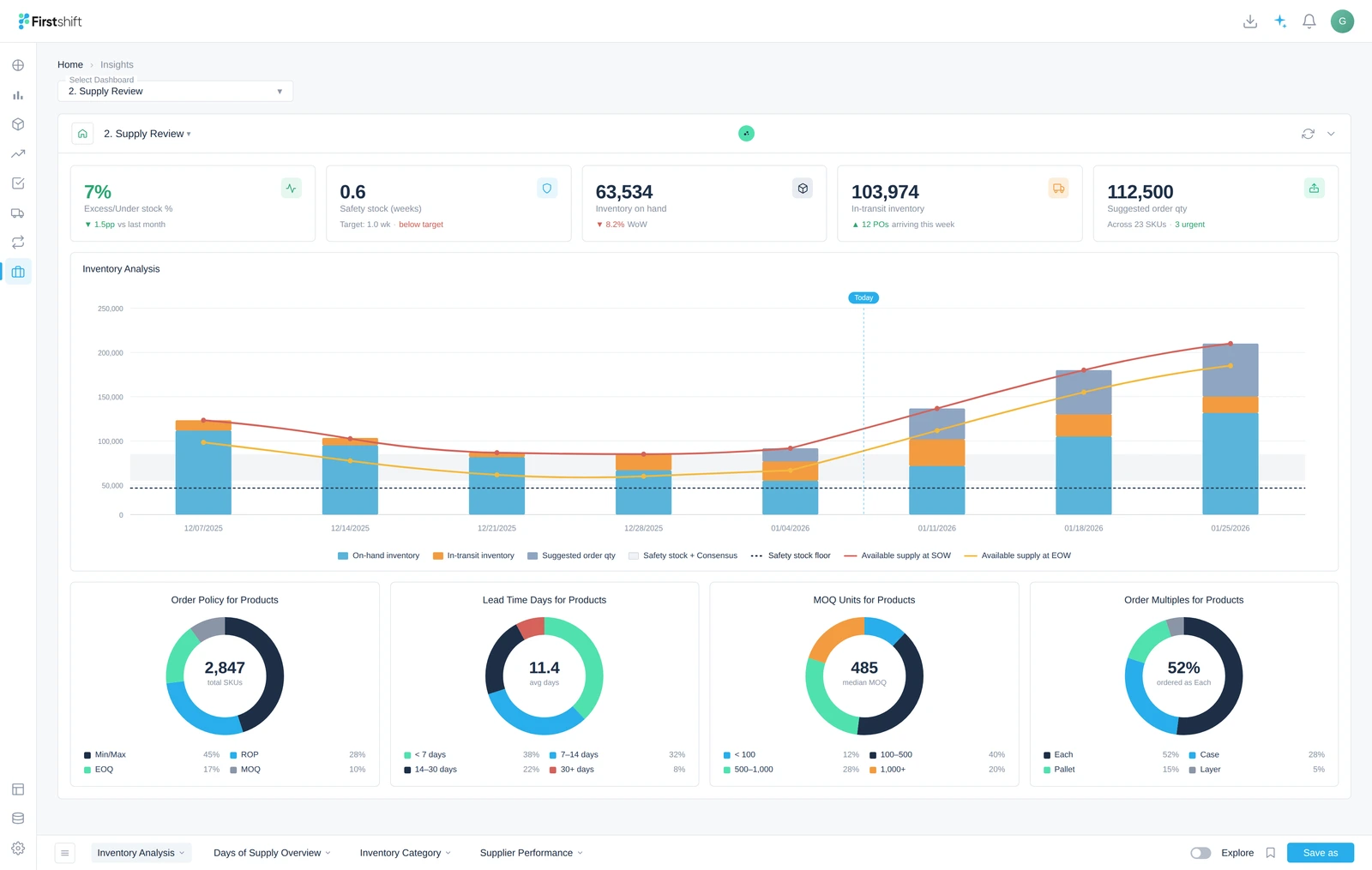
Supply chain planning software coordinates demand forecasting, inventory positioning, and production scheduling across manufacturing and distribution networks. AI-powered supply chain planning platforms like Firstshift ingest real capacity constraints, material availability, and co-manufacturer lead times to generate executable plans, replacing reactive spreadsheet-based processes and reducing planning cycle times by 10x.
Supply Chain Planning Solution
Firstshift's Supply Chain Planning Solution brings these capabilities together in one platform, purpose-built for the realities of modern manufacturing and distribution. From capacity planning and production scheduling to scenario-based decision-making, each capability works together to keep your supply plans grounded, feasible, and ready to adapt.
Adaptive Supply Planning
Continuously reconcile the supply plan against shifting demand, disruptions, and changing constraints, keeping plans executable as conditions change, not just accurate the day they're published.
Co-Manufacturing Integration
Seamlessly integrate co-manufacturer capacity and lead times into your supply plan, with visibility into external production schedules and constraints.
Material Constraint Management
Factor in material availability, supplier lead times, and procurement constraints to generate supply plans that are feasible end-to-end.
Scenario Modeling
Run what-if scenarios to evaluate trade-offs between service levels, cost, and capacity utilization. Make data-driven supply decisions with confidence.
Capacity Planning
Model available capacity across lines, shifts, and facilities to size production plans against real throughput (not theoretical maximums) before committing to a schedule.
Production Scheduling
Turn approved supply plans into sequenced, executable production schedules that account for changeovers, labor shifts, and equipment availability, so what's planned is what actually runs.
Why is Supply Chain Visibility Software Broken
Your supply chain visibility software is broken because it's built on disconnected systems and stale data. It is not because your team isn't working hard enough. Here's why that happens and what real-time visibility actually requires.
Why is supply chain planning broken for manufacturers?
Manufacturers face a fundamental mismatch between their planning systems and the pace of modern markets. Legacy tools operate on weekly or monthly planning cycles, but demand shifts daily: promotional spikes, supplier delays, and capacity fluctuations all require immediate response. Most mid-market manufacturers are managing three to five disconnected planning tools (separate systems for demand, supply, inventory, and finance) that synchronize data monthly at best. The result: supply plans that are out of date the moment they are published, planners spending 70% of their time gathering data instead of planning, and costly expedite orders or excess inventory as the default fallback. AI-native supply chain planning software solves this by unifying demand, supply, and inventory into a single adaptive plan that updates continuously as conditions change.
Why are legacy supply chain planning tools failing?
Traditional supply chain planning platforms like SAP IBP and Oracle take 12–18 months to implement, cost millions in licensing and consulting, and rely on static models that cannot adapt to real-time demand shifts. Their architecture was designed for stable, high-volume manufacturing environments, not the volatility and SKU proliferation that food, beverage, CPG, and mid-market manufacturers face today. Configuration is rigid: when business rules change, months of consultant re-work follow. Planners end up maintaining parallel spreadsheet processes outside the system because the tool cannot keep up. Modern cloud supply chain planning software like Firstshift deploys in under 8 weeks, self-configures around your data, and adapts continuously at a fraction of the total cost of ownership.
What are the risks of spreadsheet-based supply chain planning?
Organizations using spreadsheet-driven planning experience 20–40% higher forecast error rates compared to those using AI-powered demand planning platforms. Beyond forecast error, the operational risks compound quickly: a single broken formula or version-control error can propagate incorrect supply signals across the entire production schedule. Spreadsheets cannot enforce planning rules, cannot model capacity constraints, and cannot consolidate input from multiple stakeholders without data reconciliation overhead. Supply chain planners in spreadsheet-dependent organizations spend an average of 60–80 hours per month on manual data consolidation, time that should be spent on exception management and decision-making. As SKU counts grow and supply networks expand, spreadsheet-based supply chain planning becomes the single biggest constraint on planning team productivity.
Why do manufacturers lack real-time supply chain visibility?
Most manufacturers operate across four to seven disconnected data systems (ERP, WMS, TMS, spreadsheets, supplier portals, and retailer EDI feeds), none of which share a unified data model or refresh at the same cadence. Supply chain visibility breaks down because each system captures a different slice of reality at a different point in time. A production planner sees this morning's MRP run; the logistics team sees yesterday's warehouse snapshot; the sales team sees last week's order book. Decisions made on misaligned data create the costly mismatches (stockouts in one region, overstock in another) that erode margin and service levels. A supply chain control tower built on modern supply chain analytics software consolidates these signals into a single real-time view, enabling planners to detect disruptions and replan in minutes rather than days.
Make the Smart Shift
Firstshift is an AI-native supply chain planning software platform built for food and beverage manufacturers, consumer packaged goods companies, and mid-market distributors. Unlike SAP IBP, Oracle Demantra, or Kinaxis (which take 12–18 months to implement), Firstshift deploys in under 8 weeks, requires no custom development, and uses agentic AI to generate capacity-aware, constraint-driven supply plans that adapt in real time to demand shifts, supplier disruptions, and production changes.
Real Results, Measurable Impact
AI-driven supply planning replaces reactive, spreadsheet-based processes
Proactive, constraint-aware plans that adapt as conditions change. Ensure the right products are available at the right time, every time.
See It in ActionThe Firstshift approach to AI-based supply chain planning will drive increased accuracy, cost reductions and time savings in multiple areas of our global business.
Supply Chain Planning FAQs
Ready to Align Supply with Demand?
See how AI-driven supply planning can create executable plans that adapt to real constraints.