
AI-Native Demand Forecasting
Predict Demand with Confidence Using Machine Learning Forecasting
Leverage AI-native deep learning models that automatically select the best-fit forecasting algorithm, delivering accurate forecasts across product, customer, and location hierarchies so your business stays ahead of demand.
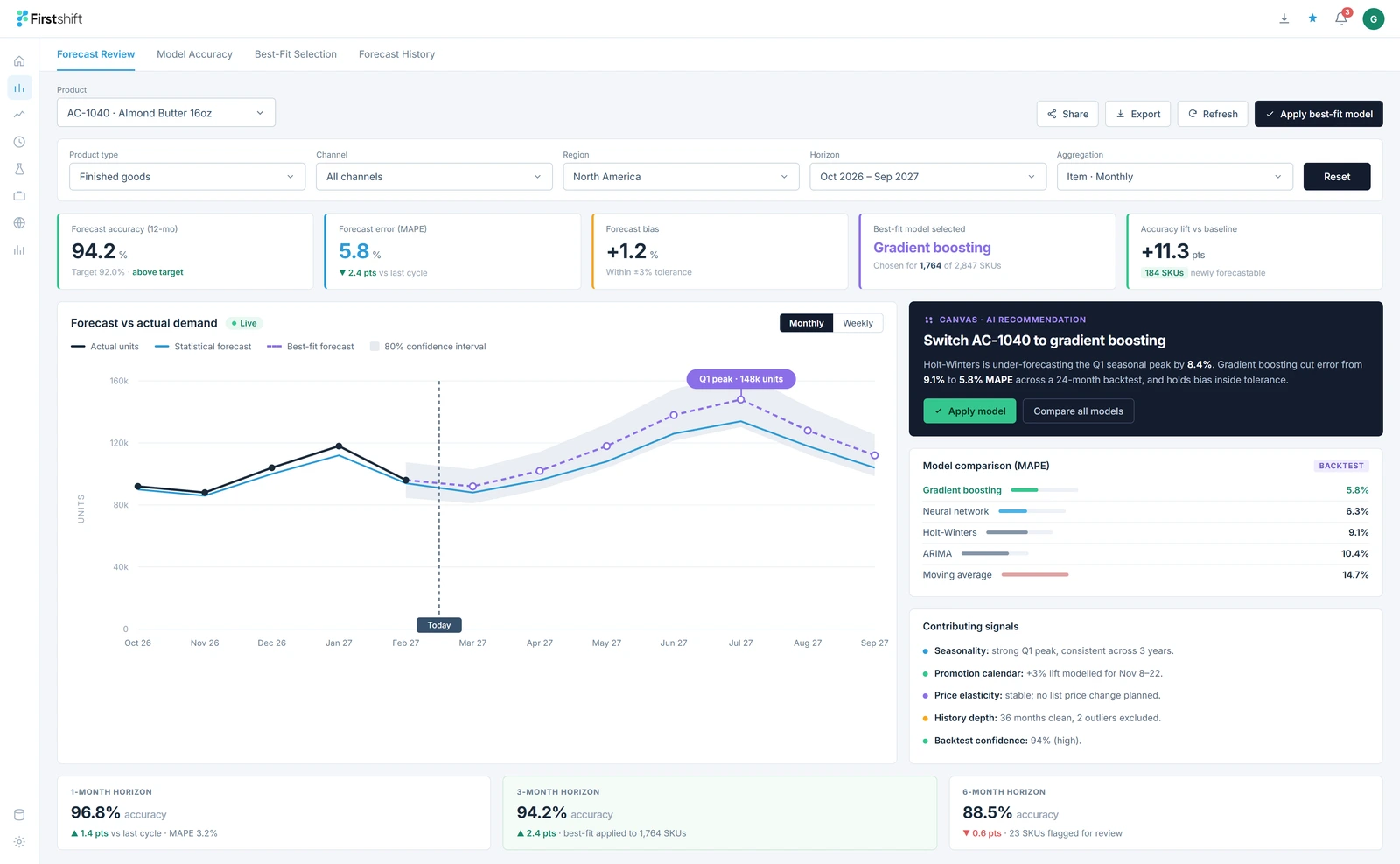
AI Demand Forecasting Platform
Firstshift's AI Demand Forecasting Platform uses historical sales data, machine learning algorithms, and external market signals to predict future product demand across SKU, customer, and location hierarchies. The AI Demand Forecasting Platform applies deep learning to auto-select the best-fit forecasting model per SKU combination, improving accuracy by 20%, detecting demand volatility, and reducing the manual effort of traditional statistical approaches.
Demand Forecasting
Best-Fit Algorithm Selection
Deep Neural Networks evaluate a rich library of statistical and ML models to automatically select the most accurate forecasting algorithm for each SKU-location combination, eliminating manual model selection.
Multi-Horizon Forecasting
Generate statistical forecasts across short, medium, and long-term horizons at any level of the product, customer, or distribution hierarchy, from brand-level down to individual SKU and location.
External Signal Enrichment
Enhance forecast accuracy by incorporating market trends, weather, promotional calendars, and economic indicators alongside internal historical data for a complete demand picture.
Forecast Accuracy Intelligence
Continuous monitoring of forecast performance with automated bias detection and exception-based alerts so planners focus effort where accuracy improvement matters most.
Why Traditional Demand Forecasting Falls Short
Why do statistical forecasting models fail in volatile demand environments?
Legacy demand forecasting tools (moving averages, exponential smoothing, ARIMA) assume demand patterns are stable. When consumer behavior shifts rapidly, supply disruptions occur, or promotional events overlap, fixed statistical models cannot adapt. Forecast error spikes above 40% MAPE because the algorithm was not designed to ingest external signals like retail POS data, weather, or competitive pricing. AI demand forecasting software using deep neural networks continuously recalibrates on new data, detecting structural changes and reducing MAPE automatically.
What is the cost of poor forecast accuracy in manufacturing?
Poor forecast accuracy has a direct financial cost: overstocked SKUs tie up working capital, under-stocked SKUs cause lost sales and premium freight charges, and inaccurate long-range forecasts lead to misaligned production capacity. Research from Gartner indicates supply chain leaders with best-in-class forecast accuracy report 15% lower inventory costs and 17% higher perfect order rates than average performers. AI demand forecasting platforms that improve accuracy by 20% can generate 5–10x ROI within the first year of deployment.
How does machine learning demand forecasting differ from traditional methods?
Machine learning demand forecasting evaluates dozens of algorithms simultaneously (from gradient boosting and neural networks to classical ARIMA and Holt-Winters models) and automatically selects the best-fit model for each SKU-location combination. Traditional methods force planners to manually choose and configure one algorithm for all products. Probabilistic demand forecasting extends this further by generating confidence interval forecasts (P10, P50, P90) rather than a single point estimate, allowing planners to optimize safety stock based on actual risk tolerance.
Make the Smart Shift
Firstshift is an AI-native demand forecasting platform built for manufacturers and distributors in food & beverage, consumer packaged goods, and industrial manufacturing. Unlike legacy forecasting tools that take 12–18 months to implement, Firstshift's deep learning engine deploys in under 8 weeks, automatically selects the best-fit forecasting algorithm per SKU-location combination, and incorporates external signals (retail POS data, weather, promotions) to reduce forecast MAPE by 20% from day one.
Real Results, Measurable Impact
AI forecasting that learns, adapts, and continuously improves
Unlike rigid statistical models, Firstshift's deep learning engine continuously recalibrates on new data, incorporating seasonality, promotions, and market shifts automatically. What took weeks now takes minutes.
See It in ActionWhat took us weeks to do in the past, we accomplish in a matter of minutes with Firstshift. And, we get a more accurate plan.
Demand Forecasting FAQs
Ready to Forecast with Confidence?
See how AI-native demand forecasting can improve accuracy, cut planning cycle time, and drive better business decisions.