
AI-Native Inventory Planning
Optimize Inventory Across Your Entire Network Using AI-Driven Replenishment
Plan inventory, safety stocks, and replenishment quantities at various stages in the supply chain network to achieve service level targets while minimizing working capital.
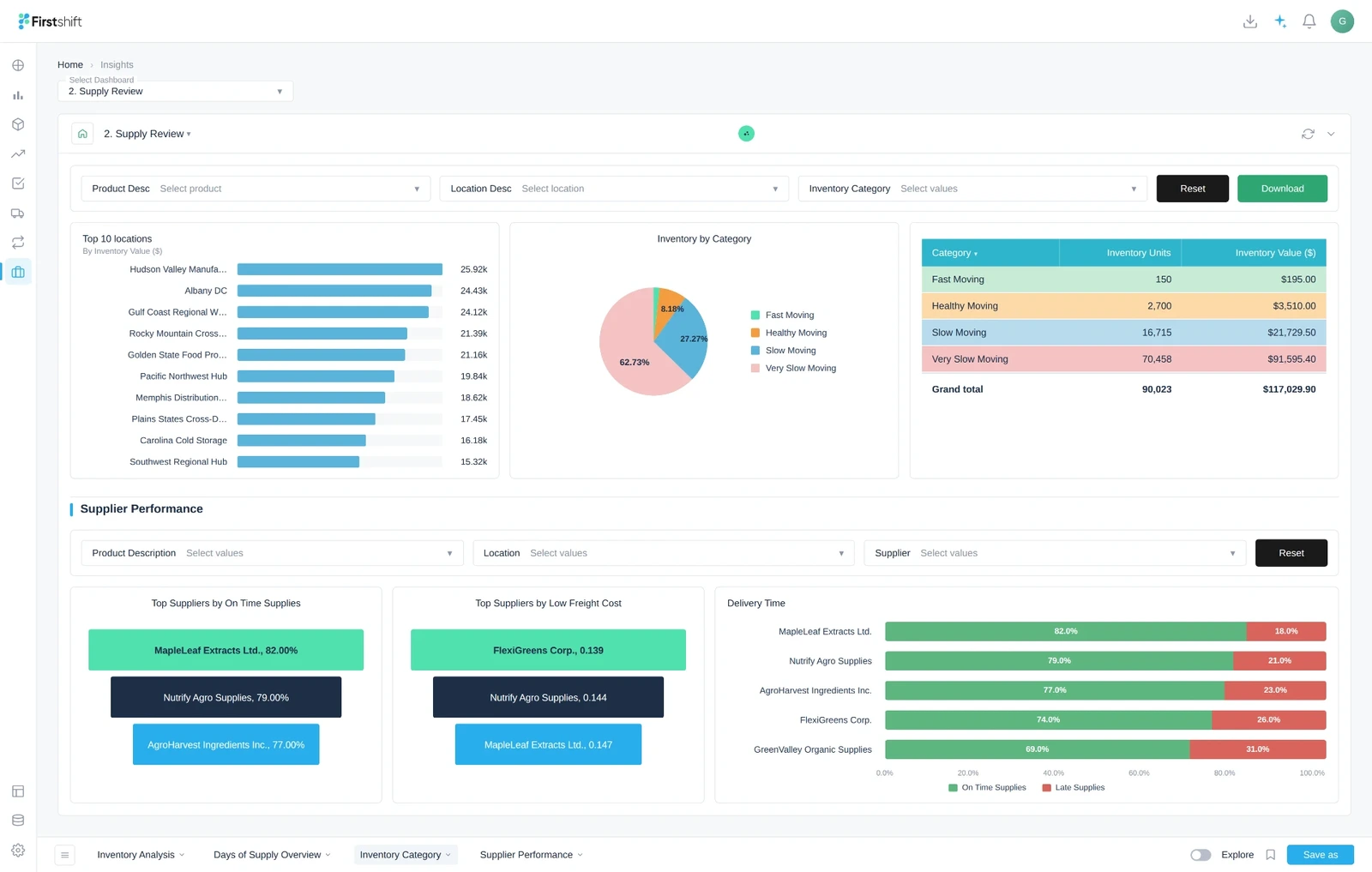
Inventory Planning Software
Inventory planning software uses demand forecasts, lead time data, and service level targets to calculate optimal stock levels (including safety stock, reorder points, and replenishment quantities) across every node in a supply chain network. AI-powered inventory planning platforms like Firstshift apply multi-echelon optimization to free working capital, prevent stockouts, and achieve 20–30% inventory reduction without sacrificing service levels.
Inventory Planning & Optimization
Inventory Classification
Automatically classify products based on demand variability and strategic importance (revenue, margin, etc.) to set differentiated policies for each segment.
AI-Driven Optimization
Algorithmic optimization triggered by both planning cadences and threshold detection. Continuously recalibrate safety stocks and reorder points based on changing conditions.
Policy Setting by Classification
Set inventory policies at different levels in the product, customer, or distribution hierarchy; each segment gets the right policy for its demand profile.
Multi-Echelon Planning
Optimize inventory across the entire supply chain network, from raw materials to finished goods, across distribution centers, warehouses, and retail locations.
Inventory Optimization Software
Inventory Optimization Software uses demand forecasts, cost variables and service level targets to determine the right inventory levels across every SKU, location and channel. AI-powered optimization platforms like Firstshift balance competing priorities like cost, cash flow and service automatically, recalculating optimal stock levels as conditions shift instead of relying on static rules. Manufacturers and distributors use it to cut excess inventory, protect service levels and free up working capital without sacrificing availability.
Why The Traditional Inventory Management Platform Fails
The Traditional Inventory Management Platform relies on static rules and periodic reviews, so it struggles to keep pace when demand, lead times or supply conditions shift mid-cycle. The result is planners falling back on spreadsheets and manual overrides just to keep recommendations relevant.
Why does excess inventory keep building despite regular planning cycles?
Most inventory planning cycles run monthly or quarterly, but demand volatility, supplier lead time changes, and promotional swings happen daily. Static reorder points and safety stock calculations set at the start of the quarter are already wrong by week two. AI inventory planning software recalibrates safety stock and reorder points continuously based on actual demand variability and lead time performance, preventing excess inventory from accumulating in the first place.
What causes stockouts even when average inventory levels look healthy?
High average inventory can mask severe imbalances at the SKU-location level. A distribution center may be overstocked on slow-moving variants while simultaneously stocking out on its top-selling SKUs, because single-echelon planning optimizes for aggregate volume, not individual product-location combinations. Multi-echelon inventory optimization evaluates every node in the network simultaneously, redistributing stock intelligently to match actual service level requirements at the SKU and location level.
How does poor inventory classification lead to suboptimal stock policies?
When all products are managed under a single inventory policy (the same safety stock formula, the same reorder point logic), high-value, fast-moving SKUs are systematically under-stocked while slow-moving, low-margin items accumulate excess. AI inventory classification automatically segments products by demand variability, strategic importance, and margin contribution, applying differentiated policies that protect service levels on critical items while freeing working capital tied up in C-class inventory.
Why is multi-echelon inventory optimization difficult without AI?
Multi-echelon inventory optimization requires solving simultaneous optimization across potentially thousands of SKU-location combinations, accounting for lead times, demand variability, and service level targets at every network node. Manual or spreadsheet-based approaches can only optimize one echelon at a time, missing the network-level trade-offs that unlock the greatest working capital savings. Firstshift's AI engine solves the full multi-echelon problem in minutes, freeing $10–20M in working capital for manufacturers.
Make the Smart Shift
Firstshift is an AI-native inventory planning software platform built for food and beverage manufacturers, consumer packaged goods companies, and industrial distributors. Unlike legacy inventory management platforms that optimize one echelon at a time, Firstshift's multi-echelon AI engine optimizes stock levels simultaneously across your entire network (from raw materials through finished goods, across distribution centers, warehouses, and retail locations), freeing $10–20M in working capital while maintaining 95%+ service levels.
Real Results, Measurable Impact
Improved forecasting combined with optimized inventory at the SKU-location level
Results in dramatically improved working capital efficiency and service levels. Cut excess inventory while never stocking out on what matters.
See It in ActionWe are expecting $10 to $20 Million in inventory reduction with Firstshift's AI-driven inventory planning.
Inventory Planning FAQs
Ready to Optimize Your Inventory?
See how AI-driven inventory planning can free up working capital and hit your service targets.