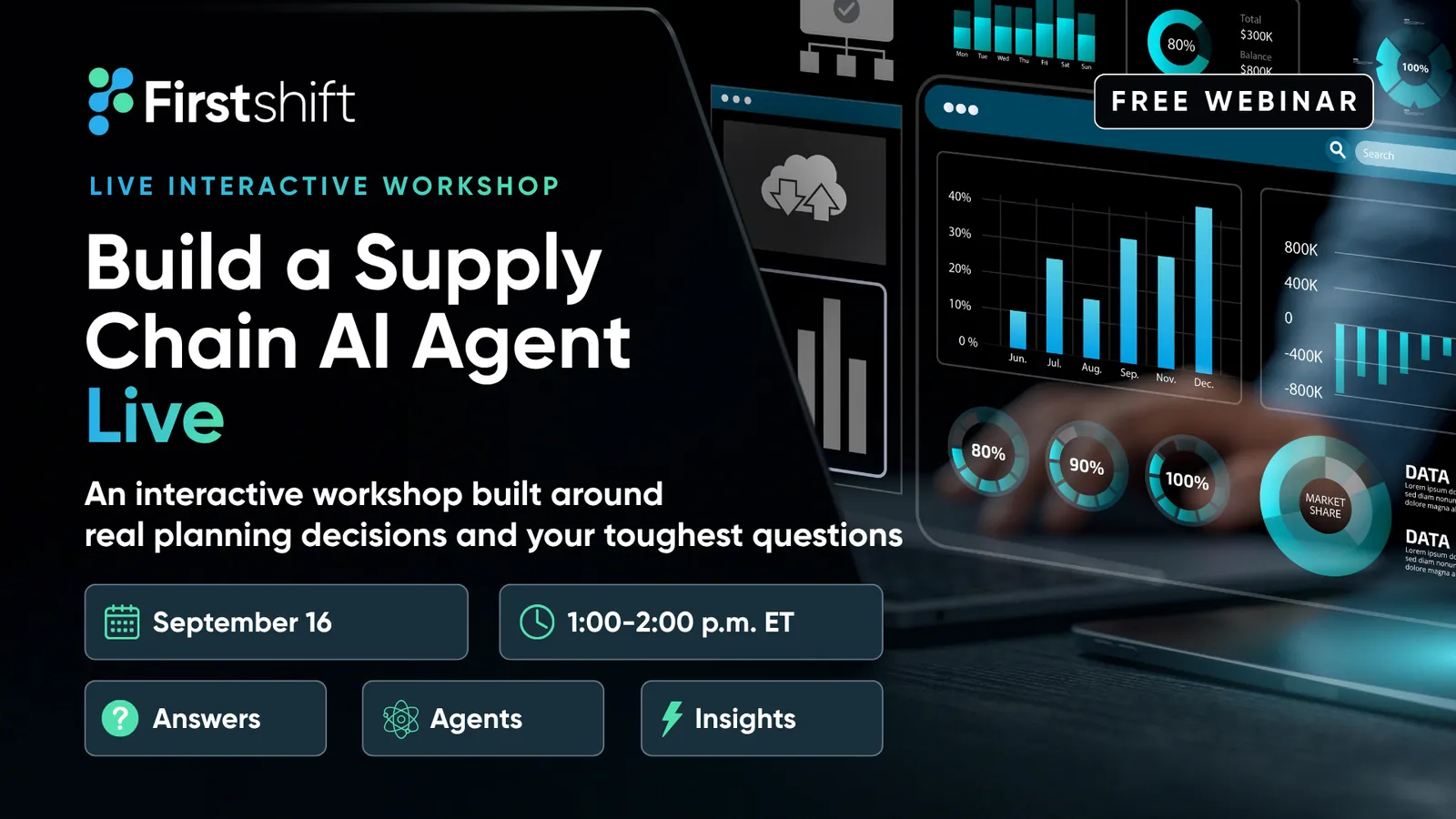
This isn’t a traditional supply chain webinar. It’s an interactive workshop.
Most planning teams have now seen an AI demo. A chat box appears, someone types a question, a number comes back. It's a good moment, and then the meeting ends and the planner goes back to the same eleven tabs, the same export, the same Monday-morning report.
The gap isn't the chat box. It's everything that has to happen after the answer.
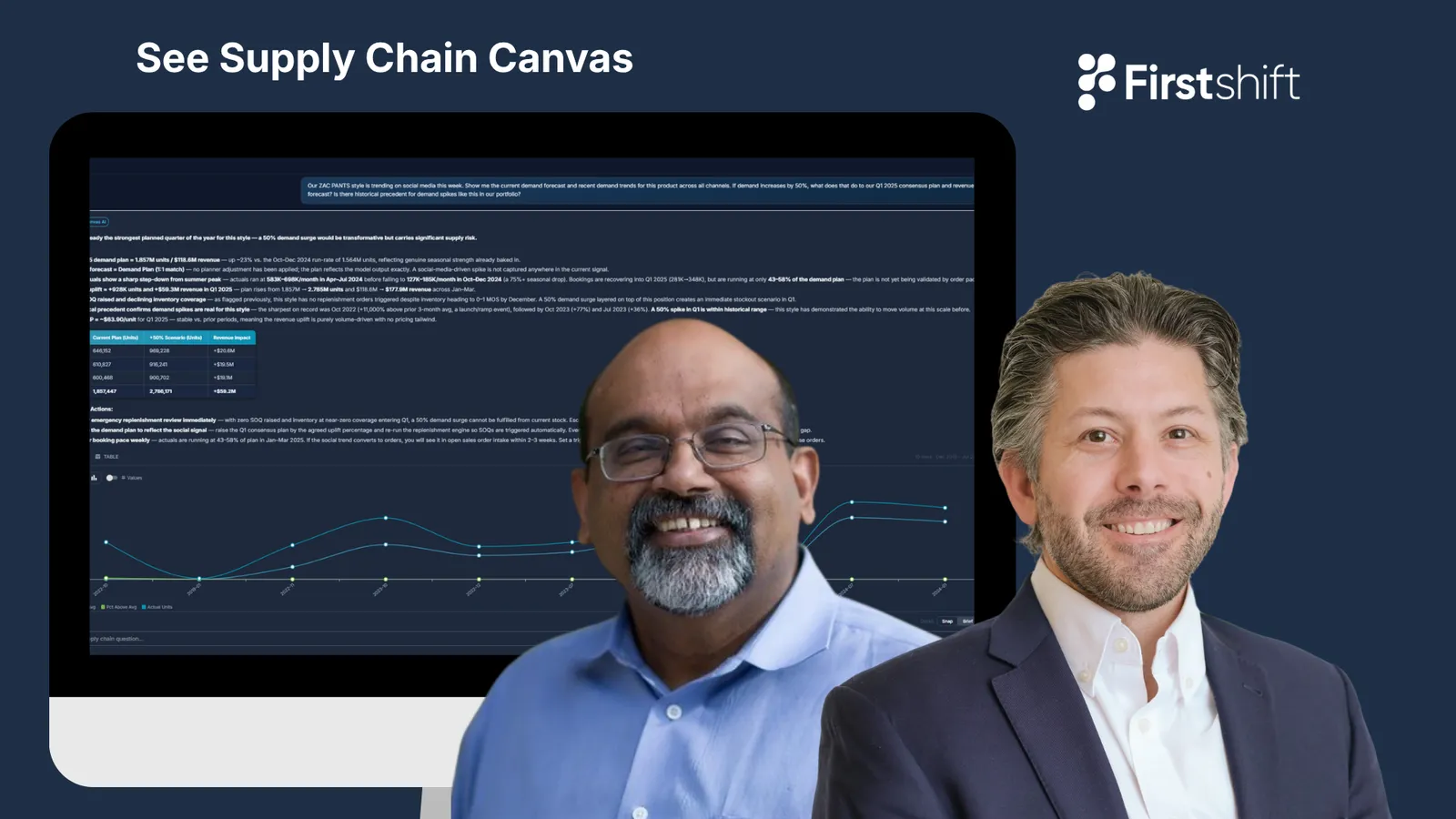
Supply Chain Canvas is built as three capabilities that cover that whole distance. Canvas Answers takes a plain-English question and returns a complete, data-backed answer (forecast, scenario, financial impact) in seconds. Canvas Agents takes the work you'd otherwise repeat every week and hands it to an agent that monitors, drafts the recommendation and routes it for approval. Canvas Insights turns a sentence into a live dashboard on your planning data, refined by conversation instead of a ticket to IT.
In this supply chain webinar, we'll walk through all three on real supply chain data.
Firstshift CEO Hari Menon opens with why the three fit together the way they do. Why an answer without an agent is a demo, and an agent without governed context is a liability. Presales Lead Grant Brantley then takes a single planning problem and follows it end to end, ask it in Answers, monitor it with an Agent, watch it in Insights, working your questions in as he goes. We'll close with open Q&A for anything still on your mind.
You'll see it working on real data in real time, not a roadmap slide.
Why Attend
See all three Canvas capabilities in one session. Answers, Agents and Insights are usually shown in isolation. Here you'll watch one real planning problem move through all three, so it's clear where each one earns its place.
Watch a plain-English question become an executable plan. Grant asks Canvas a live question (demand variation, inventory shortfall, or tariff impact), and Canvas returns the analysis, the scenarios and the financial consequence of each, with the reasoning shown rather than asserted.
See an agent do the work you're doing manually today. We'll build an agent live: define what it watches, what it decides, what it escalates and who approves it. Then we'll show what it produces without being asked.
Build a dashboard by describing it. Canvas Insights creates the chart, KPI or table from a sentence, then lets you refine it conversationally (change the metric, add a filter, or break it out by region) and save it as a shared team dashboard. No BI backlog.
Understand how Canvas stays accurate. Hari will cover the context architecture underneath Canvas and why a supply chain semantic model (not a general-purpose chatbot) is what makes the answers trustworthy enough to act on.
See how fast you can go live. Canvas layers on top of your existing systems and reaches first value in 4–6 weeks, with no rip-and-replace and no additional data migration for existing Firstshift customers.
Get your questions answered live. Bring the planning questions your team is actually stuck on. Grant and Hari will work as many as they can into the walkthrough itself, then open the floor for anything still unanswered.
Who Should Attend
VPs and Directors of Supply Chain, Demand Planning and S&OP
Supply chain planners and analysts looking for a better way to work
Operations leaders responsible for planning performance and efficiency
Finance leaders involved in S&OP and demand-driven financial planning
IT and digital transformation leaders evaluating AI for supply chain
Anyone currently running planning processes on spreadsheets, legacy platforms or rigid enterprise tools
Speakers

Hari Menon
CEO · Firstshift
Hari opens the session with why Canvas is built as three connected capabilities rather than a single assistant. He'll cover the context architecture that keeps answers grounded in your business rules, why agentic AI changes what a planning team is responsible for, and what that shift means for the organizations they serve.

Grant Brantley
Presales Lead · Firstshift
Grant demonstrates Canvas end to end on real supply chain data. He'll take a single planning problem through Answers, Agents and Insights: asking the question, reviewing the scenarios and financial impact, building an agent to monitor the condition going forward, and standing up a live dashboard by prompt. Use cases include demand variation analysis, inventory and stock-out risk, scenario planning and approval-gated workflow automation.
Explore more events
This event has ended, but there's always something new on the horizon.
View All Events