Sales & Operations Planning was designed to give a company one number — a single, agreed-upon plan that aligns sales, finance, and operations around what's actually going to happen. In practice, most organizations never get there. The process degrades into a monthly ritual: three weeks reconciling spreadsheets, then a fourth week spent in a meeting reviewing numbers that were already stale by the time they were compiled. Gartner's own research backs up how common this is — 72% of supply chain leaders say they've revisited a major planning decision at least once, and over half have gone back to the same decision three or more times. AI-powered S&OP exists to close that gap, but it only works if it fixes the workflow, not just the math.
That distinction matters because most companies have already tried to fix this with software, and the software didn't fix it.
Bolt-On Tools Automated the Math, Not the Workflow
Legacy platforms like SAP APO, Anaplan, Logility, and ToolsGroup did real work — they replaced manual forecasting math and gave planning teams a system of record. But the gap between S&OP's promise and its results persisted anyway, for reasons that have nothing to do with the quality of the algorithms. Most of these systems run on nightly or weekly batch extracts, so the numbers in the room are already a week behind the business by the time anyone discusses them. Their forecasting engines handle historical demand well but absorb qualitative input poorly — a sales rep's read on a customer, a competitor's stockout, a weather event — without a manual override. Sales thinks in customers, finance thinks in GL codes, and operations thinks in SKU-location, and the software rarely reconciles these hierarchies natively, so a shadow spreadsheet ends up doing the translation anyway. Updating those hierarchies or workflows takes a specialized administrator, so the system lags the business it's supposed to serve. And when the tool is harder to use than Excel for an ad-hoc question, planners quietly revert to Excel, and the official system of record becomes a formality nobody actually works from.
The tooling changed. The underlying process — batch data, rigid models, manual reconciliation, no connection to execution — didn't.
The Hidden Cost Nobody Labels "S&OP"
None of this shows up on a P&L as a line item called "S&OP cost," which is exactly why it persists. It shows up as working capital drag, where poor consensus forecasts push planners toward blanket safety stock that ties up cash across the network. It shows up as stockouts and lost sales, because a monthly cadence can't react to a real demand shift, so revenue leaks even while inventory sits in the wrong location. It shows up as expedite costs, when a missed plan forces premium freight or overtime production to recover. It shows up as markdowns and obsolescence, when overproduction against a forecast that was already stale gets liquidated at a loss. And it compounds through bullwhip amplification — disconnected sales, finance, and operations numbers exaggerate variance as they move upstream, inflating supply chain cost far beyond the actual change in demand. The process looks static from the outside. The money is moving constantly.
What an AI-Powered S&OP Workbench Actually Looks Like
Supply Chain Canvas is built around a different premise: planning should happen in natural language, against live data, with instant iteration — not through a spreadsheet handoff followed by a scheduled meeting. Planners ask questions and adjust plans conversationally instead of building pivot tables. The Canvas reflects current ERP and transactional state rather than last week's batch extract. A question like "what if demand drops 15% in the Southeast" returns a grounded answer in seconds, not after a re-extract-and-rerun cycle that used to take days.
That shift changes every stage of the S&OP calendar, not just the tooling underneath it. In the demand review, statistical forecasts blend with qualitative signals conversationally, so a sales override isn't a separate spreadsheet column — it's a prompt. In the supply review, planners see constraint-aware plans live, with capacity, lead time, and supplier limits factored in as the plan is discussed rather than after. Reconciliation happens on one shared Canvas instead of three spreadsheets stitched together the night before the meeting. And the executive review becomes a live decision forum — a leader can ask a follow-up question and get an answer on the spot instead of waiting for the next monthly cycle.
Closing the Gap Between Plan and Execution
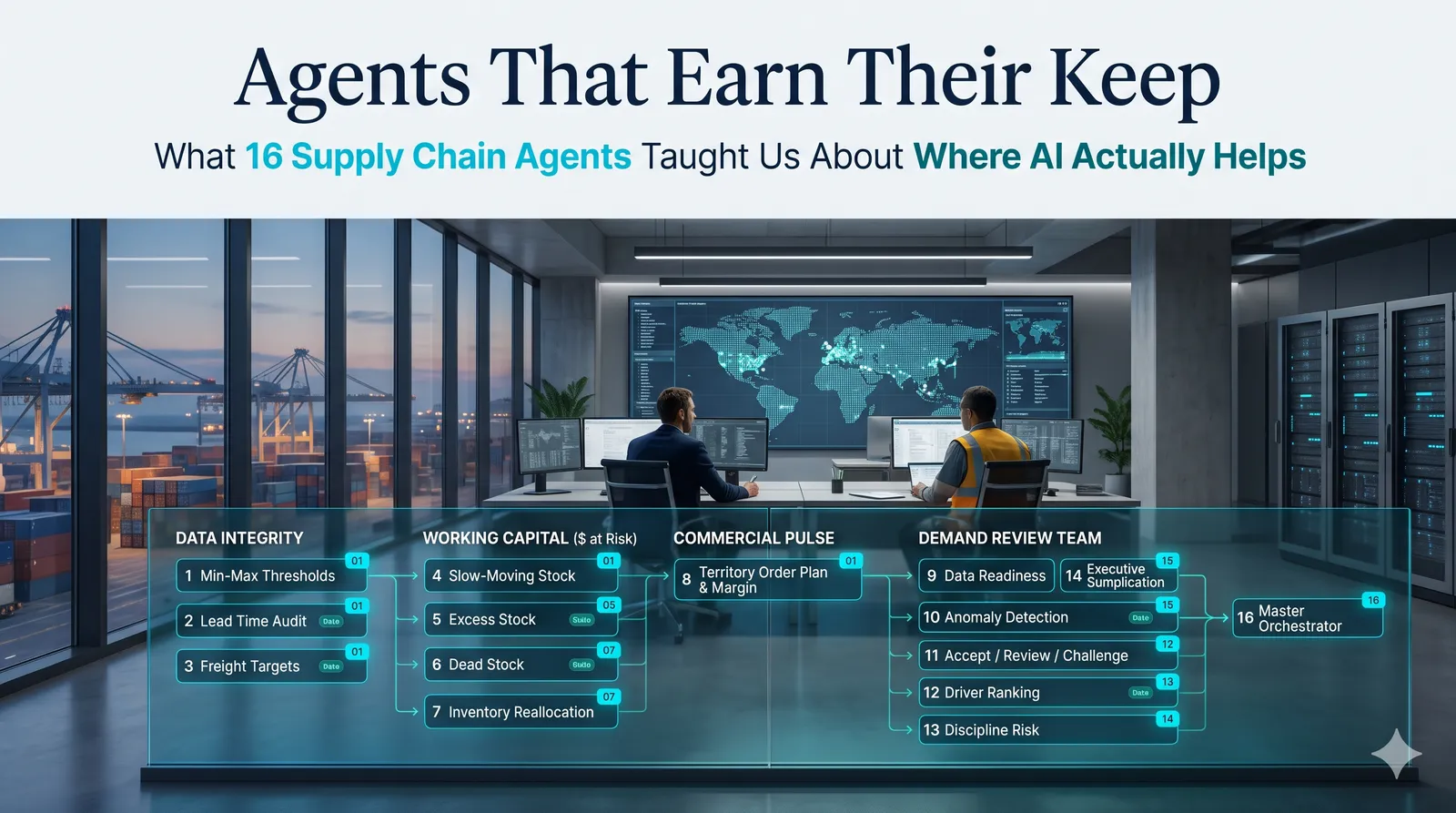
A plan that never touches execution is just a forecast. Supply Chain Canvas is designed to close that gap directly: agents such as the Reorder Point Agent and the Demand Anomaly and Replan Agent translate an approved plan into replenishment and inventory actions, and flag deviations the moment they happen rather than at the next scheduled review. That also solves the adoption problem that undermines most legacy deployments — planners revert to Excel because Excel is faster for an ad-hoc question. When the natural-language interface is faster than a spreadsheet for the same question, the system of record and the tool planners actually reach for become the same thing. Adoption follows from speed, not a mandate.
The end state isn't a faster version of the monthly meeting. It's the retirement of the monthly meeting as the unit of planning. Consensus, scenario testing, and execution tie-back happen continuously, and the meeting becomes a checkpoint on a process that never actually stopped running — which is what S&OP was supposed to be all along.
If your S&OP cycle still runs on batch extracts and a shadow spreadsheet, it's worth seeing what a live, natural-language planning session looks like against your own data. Book a walkthrough of Supply Chain Canvas.
FAQs about AI-Powered S&OP Software
Why does S&OP fail at most companies?
Legacy software automated the math but not the workflow. Teams spend three weeks reconciling spreadsheets, then a fourth week reviewing numbers that were already stale. Gartner research found 72% of supply chain leaders have revisited a major planning decision at least once, and over half have gone back to the same decision three or more times.
What is AI-powered S&OP?
AI-powered S&OP replaces batch-extract, spreadsheet-reconciliation workflows with continuous, natural-language planning against live data. Planners ask questions and adjust plans conversationally. The system reflects current ERP and transactional state. A question like 'what if demand drops 15% in the Southeast' returns a grounded answer in seconds, not days.
What are the hidden costs of bad S&OP?
Poor S&OP shows up as working capital drag from blanket safety stock, stockouts and lost sales from a monthly cadence that can't react to demand shifts, expedite costs from premium freight and overtime, markdowns and obsolescence from overproduction against stale forecasts, and bullwhip amplification where disconnected numbers exaggerate variance upstream.
What's wrong with legacy S&OP tools like SAP APO, Anaplan, and Logility?
They run on nightly or weekly batch extracts so numbers are already stale, they absorb qualitative input poorly without manual overrides, they don't reconcile the different hierarchies used by sales, finance, and operations natively, updating workflows requires a specialized administrator, and they're harder to use than Excel for ad-hoc questions — so planners quietly revert to spreadsheets.
How does Supply Chain Canvas improve S&OP?
Canvas changes every stage of the S&OP calendar. Demand review: statistical forecasts blend with qualitative signals conversationally. Supply review: constraint-aware plans shown live. Reconciliation: one shared Canvas instead of three spreadsheets. Executive review: a live decision forum where leaders ask follow-ups and get answers on the spot.
How does AI close the gap between S&OP plan and execution?
Supply Chain Canvas agents like the Reorder Point Agent and Demand Anomaly and Replan Agent translate approved plans into replenishment and inventory actions, flagging deviations the moment they happen. The natural-language interface is faster than a spreadsheet for ad-hoc questions, so the system of record becomes the tool planners actually reach for.
Can AI-powered S&OP replace the monthly planning meeting?
The end state is retirement of the monthly meeting as the unit of planning. Consensus, scenario testing, and execution tie-back happen continuously, and the meeting becomes a checkpoint on a process that never actually stopped running — which is what S&OP was supposed to be all along.
What is bullwhip amplification in S&OP?
Bullwhip amplification occurs when disconnected sales, finance, and operations numbers exaggerate variance as they move upstream, inflating supply chain cost far beyond the actual change in demand. It compounds when planning hierarchies aren't natively reconciled — one of the hidden costs of poor S&OP.
Ready to see Firstshift in action?
Request a personalised demo and see how Firstshift can transform your supply chain planning.