Everyone in supply chain is talking about AI agents right now. Very few people are talking about what the agents do on a Tuesday morning when a planner opens their laptop.
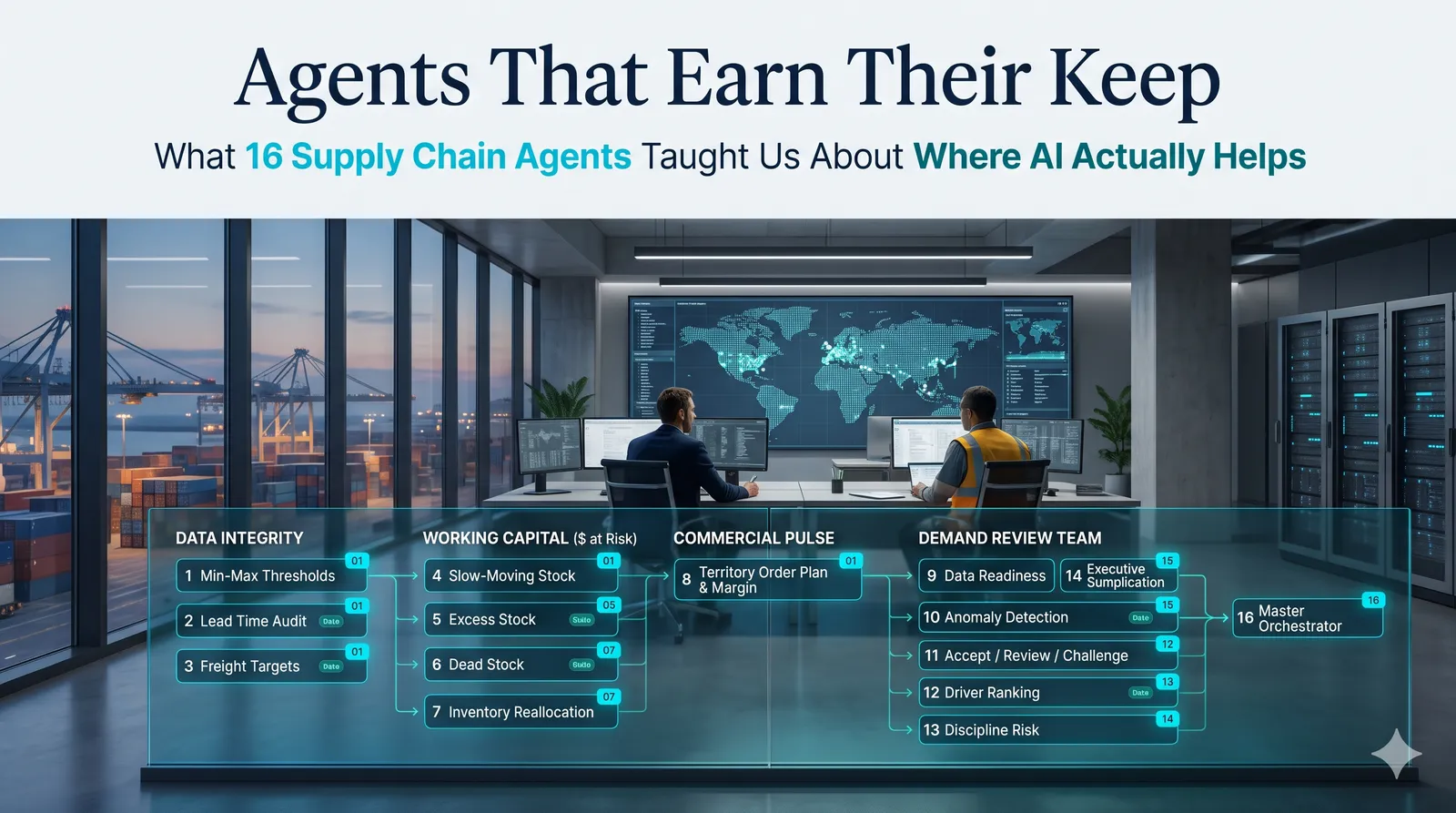
At Firstshift, we've deployed 16 agents across three customers: a specialty industrial distributor, an equipment manufacturer with a dealer network, and a global agribusiness. Some are running in production. Others are about to go live. Several are still being shaped with the customer. Together they've taught us more about what "agentic planning" really means than any whitepaper could.
Here's what we've learned.
1. The first agent you need is usually a data integrity agent
When we started working with the distributor, the obvious ask was better replenishment. The real problem was that the inputs feeding replenishment couldn't be trusted.
So the first three agents we built don't plan anything. They check things:
A min-max threshold review agent compares the thresholds we calculate with the ones configured in the customer's ERP, then ranks which mismatches are worth fixing first. That ranking matters. A list of 4,000 discrepancies is noise. A list of the 40 that matter is a work plan.
A lead time discrepancy agent finds product-locations with missing or outlier lead times, the quiet errors that throw off replenishment timing for months before anyone notices.
A freight target agent flags suppliers being ordered well above or below their negotiated freight thresholds, where money is leaking without anyone deciding it should.
This is unglamorous work. It's also where agents create value fastest, because humans are bad at checking thousands of parameters every week and agents never get bored.
2. Inventory is working capital, so agents should talk in dollars
The next three agents for the same distributor focus on inventory health: slow-moving stock, excess above demand-based thresholds, and dead stock with zero turns.
The design choice that matters is that every one of them ranks its findings by dollars at risk, not by SKU count. A CFO doesn't care that 600 items are slow-moving. They care that $2M is sitting in three locations and that a transfer, markdown, or supplier return could free it up. When agents speak the language of the P&L, planning stops being a back-office function.
3. Agents can watch the business plan, not just the supply plan
For the equipment manufacturer, the challenge wasn't inventory. It was visibility into commercial execution across a regional sales organization.
We built a territory pulse agent that tracks each regional sales territory against the order plan in units, revenue, and margin. It flags customers who are slipping, dealers who have gone quiet, and margin erosion before it shows up in the quarter, then sends weekly, monthly, and quarterly reports to the right people automatically.
The point is that an agent doesn't have to sit inside a planning screen. It can be the colleague who reads every territory's numbers every week and only bothers you when something is moving the wrong way.
4. The real unlock is a team of agents, not a single agent
Our most ambitious design is with the global agribusiness, and it's where the future of planning becomes visible.
Their monthly demand review is a heavy, manual process: dozens of markets submit forecasts, and planners spend days checking, reconciling, and challenging them. We've designed nine agents that work as a team:
One validates every demand submission for data quality and business rules, then publishes a readiness score.
One flags unusual demand moves against the last published cycle, with a severity rating.
One gives each location an Accept / Review / Challenge verdict based on variance to budget, commercial plan, and consensus, plus product-mix shifts. This agent is live in production.
One ranks the biggest demand changes between cycles and explains what drove them.
One scores forecasting discipline by market and assigns a risk level.
One merges and de-duplicates every issue the other agents raise into a single High / Medium / Low action list.
One writes the executive summary of the cycle.
A master orchestrator runs the specialist agents in sequence and publishes one consolidated report.
On the supply side, a separate inventory reallocation agent, also live in production, looks for stranded or excess inventory elsewhere in the network that could cover demand before anyone recommends new production. Every unit of existing stock that gets reallocated is a production run, a freight cost, and a carrying cost you don't pay.
When agents are designed as a team, each one has a narrow job, a clear output, and a handoff. Planners stop hunting for problems and start making decisions on a prioritized list.
5. What we've learned about building agents that stick
Across all 16, a few principles keep coming up:
Narrow beats general. Each agent does one job well. The orchestration layer handles the complexity.
Rank, don't dump. Every agent's output is prioritized. If a planner has to sort the output, the agent hasn't finished its job.
Start where trust is earned. Data integrity and inventory health agents build confidence quickly because their findings are verifiable. That trust is what earns agents a seat in higher-stakes decisions like demand consensus.
Humans stay in the loop. Verdicts like Accept / Review / Challenge are designed to focus human judgment, not replace it.
Deploy incrementally. Two agents live, six ready to deploy, others in review or being shaped with the customer. That's not a weakness. That's how you put AI into operations responsibly.
The bottom line
Agentic supply chain planning isn't one giant brain that runs your business. It's a set of specialized, tireless colleagues that check the data, watch the capital, monitor the plan, and hand your planners a short list of things that matter.
That's the future we're building at Firstshift, one agent at a time.
If you're thinking about where agents could take work off your planning team's plate, I'd love to compare notes.
Ready to see Firstshift in action?
Request a personalised demo and see how Firstshift can transform your supply chain planning.