Every planning organization is asking some version of the same question right now: should we build our own AI agents on top of a large language model, or buy a platform that already does it?
It's a reasonable question. Foundation models are more capable and more accessible than ever, and it's tempting to assume that a generic LLM plus a few internal engineers can deliver the same outcome as a purpose-built platform. In our experience working with supply chain and planning leaders across CPG, industrial distribution, agriculture, and food and beverage, that assumption rarely survives contact with reality — and the pace of the underlying technology is a big reason why.
The frontier is moving faster than any one team can track
Global investment in generative AI has grown roughly 160x since 2019, from under $1 billion to more than $140 billion in 2025, according to the Stanford HAI AI Index and Epoch AI data published via Our World in Data. Behind that number is a torrent of new model families, agent frameworks, evaluation techniques, and safety practices, arriving every few months rather than every few years.
For a technology company, keeping pace with that curve is the job. For a supply chain or planning organization, it's a full-time discipline layered on top of the actual job: forecasting demand, managing inventory, and keeping S&OP aligned. That's the core tension behind the build-vs-buy decision, and it's why we built Firstshift's Supply Chain Canvas the way we did — as a purpose-built AI layer for planning, not a chatbot wrapped around a generic model.
Here are the five places where that distinction matters most.
1. Domain grounding
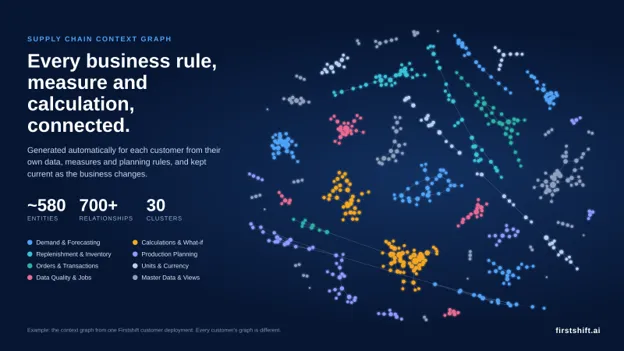
A general-purpose LLM has no native concept of a SKU-location, a lead time, or an S&OP cycle. It doesn't know that a stockout in one region can be a planned trade-off against carrying costs in another, or that a “safety stock” recommendation means something different for a perishable good than for industrial equipment. Teaching a generic model this context from scratch is most of the engineering effort in a DIY build — and it has to happen before the agent produces a single trustworthy answer. Canvas starts from a native supply chain ontology, so that grounding is already done.
2. Accuracy and trust
Hallucination risk isn't an edge case in planning — it's the whole risk. A confidently wrong answer about safety stock or supplier lead time can drive a real, costly decision. Building the evaluation harnesses, guardrails, and grounding pipeline that keep an LLM's answers tied to live, accurate planning data is a substantial and ongoing engineering investment. In Canvas, every answer and recommendation is grounded in your live planning data by design, not as an afterthought.
3. Governance
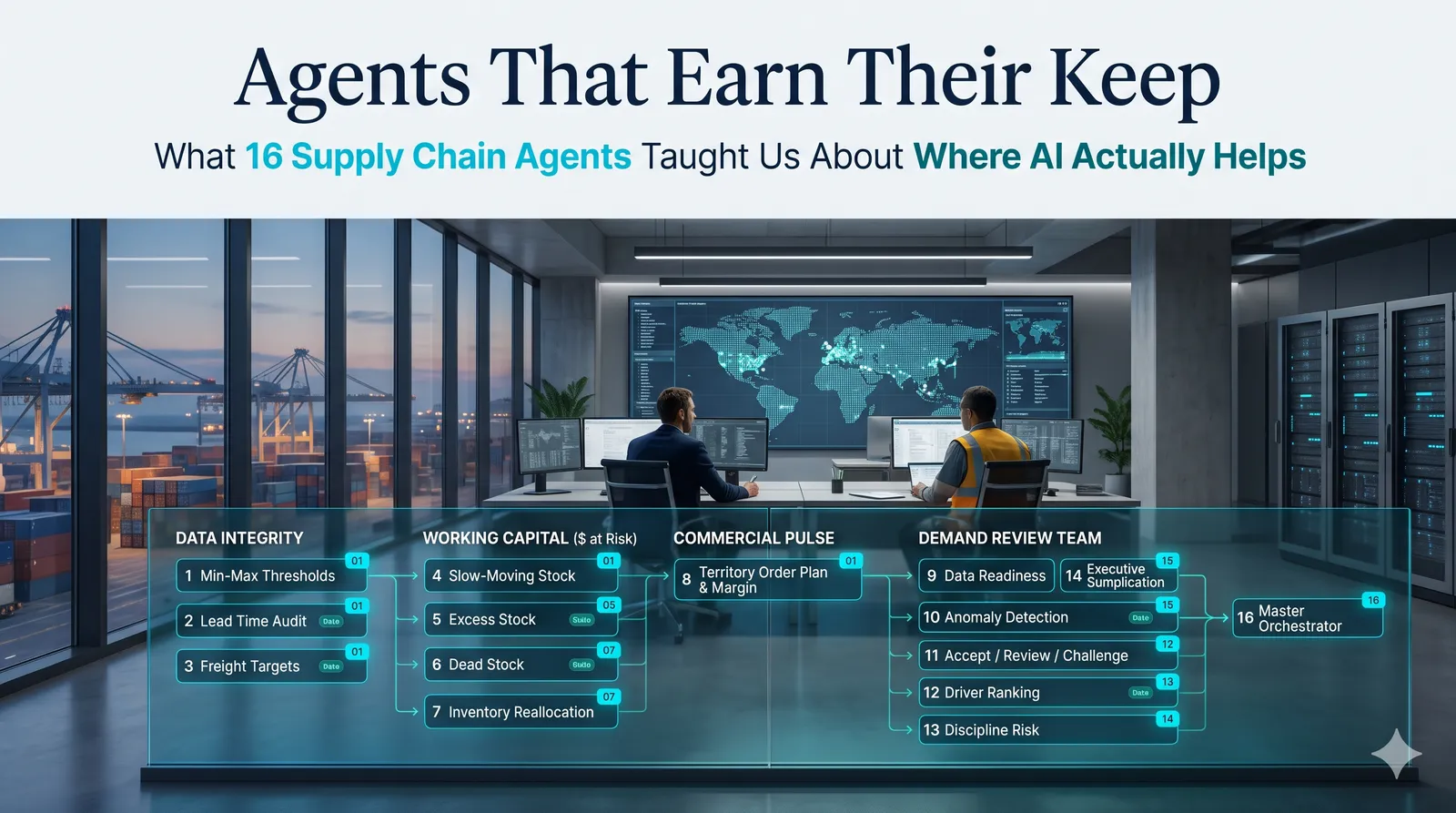
Once agents move from answering questions to taking action — adjusting a forecast, triggering a replenishment, escalating a supply risk — governance stops being optional. Who approves what? What gets logged? When does a human need to be in the loop? These are hard, non-trivial questions to design and implement well. Canvas ships with Insights Agents, Task Agents, and Workflow Agents that include human-in-the-loop escalation and audit trails from day one.
4. Total cost of ownership
An internal LLM stack isn't a one-time build. It's an ongoing commitment: data scientists and engineers to maintain it, infrastructure to host it, and a growing surface area of models, prompts, and integrations to keep working as everything around them changes. A single platform subscription replaces that standing team and infrastructure cost — which is often the biggest, least visible line item in a build-it-yourself business case.
5. Staying evergreen
Perhaps the most underestimated cost of a DIY build is what happens after launch. New model versions ship. Old ones get deprecated. Best practices shift. Someone has to own that upgrade cycle indefinitely, or the system quietly falls behind the frontier it was built on. An evergreen platform absorbs that churn on your behalf, through continuous automatic updates, so your team never has to run a re-platforming project just to stay current.
Build it yourself vs. Supply Chain Canvas, side by side
| Dimension | Build It Yourself (LLM) | Firstshift Supply Chain Canvas |
|---|---|---|
| Time to First Value | 6–12+ months of engineering before agents work | Less than 4 weeks to first value |
| Domain Grounding | Generic LLM has no native concept of SKU-location, lead time, S&OP | Built-in supply chain ontology and planning logic |
| Accuracy & Trust | Hallucination risk; eval and guardrails built from scratch | Answers grounded in your live planning data |
| Governance | You design orchestration, memory, and human-in-the-loop yourself | Insights, Task & Workflow Agents with escalation built in |
| Total Cost of Ownership | Ongoing data science and engineering headcount to build and maintain | Single subscription; no dedicated AI team required |
| Evergreen Platform | Your team owns every model upgrade, prompt drift, and retraining cycle | Continuous automatic updates keep you on the frontier |
| System Integration | Custom connectors per ERP, owned and maintained by your team | Native SFTP, S3, Azure, REST API, and Snowflake integrations |
| Security & Compliance | Certifications and audits are your responsibility to build | SOC 2 Type 2, GDPR-ready, 99.5% SLA out of the box |
The real question isn't “can we build this”
Most engineering-capable organizations probably could build a version of this, given enough time and headcount. The real question is whether that's the best use of a planning team's time and a technology budget, in a market where the underlying models are being rebuilt every few months by companies whose sole focus is exactly that.
Domain expertise meets the power of AI — that's the premise Supply Chain Canvas is built on. If you're currently weighing a build-vs-buy decision for AI in your own planning organization, we'd welcome the conversation.
FAQs
Should I build or buy AI for supply chain planning?
Most engineering-capable organizations could build a version, but the real question is whether that's the best use of a planning team's time and a technology budget. Building requires 6-12+ months before agents work, ongoing headcount to maintain them, and the burden of keeping up with a frontier being rebuilt every few months. A purpose-built platform like Firstshift Supply Chain Canvas delivers first value in less than 4 weeks with domain grounding, governance, and evergreen updates included.
What is domain grounding and why does it matter for supply chain AI?
Domain grounding means the AI natively understands supply chain concepts like SKU-location, lead time, S&OP cycles, and the difference between perishable and industrial safety stock. A generic LLM lacks this context entirely. Teaching it from scratch is most of the engineering effort in a DIY build. Supply Chain Canvas starts from a native supply chain ontology, so that grounding is already done.
What is AI hallucination risk in supply chain planning?
Hallucination risk is when an AI produces a confidently wrong answer. In supply chain, a hallucinated safety stock or lead time answer can drive a real, costly decision. Building evaluation harnesses, guardrails, and a grounding pipeline to prevent this is a substantial and ongoing engineering investment. In Canvas, every answer is grounded in live planning data by design, not as an afterthought.
Why does governance matter for AI supply chain agents?
Once agents move from answering questions to taking action (adjusting a forecast, triggering replenishment, escalating supply risk), governance is critical. Who approves what? What gets logged? When does a human need to be in the loop? Canvas ships with Insights Agents, Task Agents, and Workflow Agents that include human-in-the-loop escalation and audit trails from day one.
What's the total cost of building your own AI supply chain stack?
An internal LLM stack isn't a one-time build. It requires ongoing data scientists, engineers, hosting infrastructure, and a growing surface of models, prompts, and integrations to maintain. That standing team and infrastructure cost is often the biggest, least visible line item in a build-it-yourself business case. A single platform subscription replaces that entire cost.
What does 'evergreen platform' mean?
An evergreen platform absorbs the churn of new model versions, deprecated old ones, and shifting best practices through continuous automatic updates, so your team never has to run a re-platforming project just to stay current. Without this, someone owns the upgrade cycle indefinitely, or the system quietly falls behind.
How fast can Supply Chain Canvas deliver value compared to a DIY build?
A DIY LLM build typically requires 6-12+ months of engineering before agents produce trustworthy answers. Supply Chain Canvas delivers first value in less than 4 weeks because the domain model, grounding, governance, and integrations ship built-in.
How much has global investment in generative AI grown?
According to the Stanford HAI AI Index and Epoch AI data, global investment in generative AI has grown roughly 160x since 2019, from under $1 billion to more than $140 billion in 2025. Behind that number is a torrent of new model families, agent frameworks, evaluation techniques, and safety practices arriving every few months.
Ready to see Firstshift in action?
Request a personalised demo and see how Firstshift can transform your supply chain planning.