Agentic AI for supply chain planning allows planners to ask questions in plain English and receive instant, data-driven answers including demand forecasts, supply plans, S&OP scenarios and financial impact analysis. Planners can also build and deploy agents that automate repeated tasks and workflows. Unlike dashboard-based planning tools that require navigation, query languages and manual data gathering, agentic AI planning uses large language models combined with domain-specific reasoning to turn natural-language questions into executable plans in seconds. Firstshift released Supply Chain Canvas, the first agentic AI solution purpose-built for end-to-end supply chain planning, decision intelligence and execution.
Why Does AI in Supply Chain Planning Still Feel Like a Buzzword?
Every supply chain software vendor claims to offer AI. But for most planning teams, the day-to-day experience hasn't changed.
A McKinsey study found that close to three-quarters of supply chain functions still rely on spreadsheets as their primary planning method, and the Corporate Finance Institute estimates the error rate in those spreadsheets to be as high as 88%. Meanwhile, PwC's 2025 Digital Trends in Operations Survey, based on insights from 610 operations and supply chain leaders, found that 82% face challenges balancing short-term operational needs with long-term strategic planning.
The "AI" embedded in most planning platforms amounts to statistical models rebranded with a new label. The interface is the same: dashboards, modules, grids. The process is the same: pull data, build a model, run a report, format a presentation. The cycle still takes 10–15 business days. The AI that planners experience in the rest of their lives, conversational, contextual, instant, hasn't made it into the planning function.
Until now. That gap is exactly what we built Supply Chain Canvas to close.
What Is Supply Chain Canvas and How Does It Work?
Supply Chain Canvas is a new agentic AI solution within the Firstshift platform that gives planners a single window to generate insights, run scenarios and act. Instead of navigating dashboards and building spreadsheet models, planners describe what they need in plain English and receive a complete, data-driven response in seconds. They can also build agents that automate repeated tasks and workflows.
The process follows three steps:
Ask: A planner types a question, scenario or what-if. Examples include "What happens to our margin if demand drops 15% in Q3?" or "Where's the closest available inventory to cover a stockout at the Texas warehouse?"
Compute: Canvas queries the organization's Firstshift data, ingests relevant external signals like tariffs, weather, commodity prices, port conditions and supplier risk, then runs in-memory simulations across millions of SKU-location combinations.
Execute: The planner receives demand forecasts, supply plans, S&OP scenarios and financial impact analysis. Results can be exported directly to PowerPoint or PDF for stakeholder presentations.
No training is required. No query language to learn. No modules to master. Canvas is designed so any planner can use it from day one.
Planners can also build agents that handle repeated tasks on a recurring basis, from generating weekly forecast reviews to flagging anomalies before the S&OP meeting. The manual work gets automated so planners can focus on higher-value decisions.
How Much Time Do Planners Actually Spend on Manual Work?
The answer is sobering, and it's backed by industry data.
According to PwC's 2025 survey, 91% of supply chain leaders say trade policy changes are forcing them to significantly rethink their strategies, while 87% cite geopolitical risk as a driver of operational change. Yet the tools most teams use to respond to these pressures haven't evolved to match the speed those conditions demand.
A Bizagi study of the manufacturing sector found that one in three respondents said manual tasks consumed more than 50% of their working time. Supply Chain Dive and West Monroe reported that nearly 75% of manufacturing and distribution executives still use Microsoft Excel as part of their S&OP process.
With Supply Chain Canvas, that same scope of work is completed in approximately 30 minutes through a series of conversational interactions. The time savings come from automating the data gathering, reconciliation, simulation and reporting steps that currently consume the vast majority of planner effort.
How Is Agentic AI Different From the "AI" Already in Planning Tools?
The distinction matters because it affects who can use the technology and how fast value is realized. McKinsey's research on supply chain IT modernization found that 60% of planning technology implementations take more time or money than expected, or fail to achieve anticipated business outcomes. A major reason is complexity: long deployments, heavy training requirements and tools that demand specialized skills to operate.
Canvas takes the opposite approach. There is no implementation in the traditional sense for existing Firstshift customers. Deployment takes as little as two weeks. Time to ROI is under six months. And total cost of ownership runs 5–10x lower than legacy planning platforms because there are no modules to customize, no consultants to hire and upgrades are continuous and automatic.
What Can Planners Actually Do With Agentic AI?
The use cases span the full scope of supply chain planning. By automating the data to action pipeline, Supply Chain Canvas shifts planning teams away from manual work and toward higher-value decision-making. Organizations can reduce planning effort by up to 80 percent while expanding each planner’s ability to manage more SKUs, locations, customers and scenarios. Here are four use cases that demonstrate the breadth of what Canvas handles today.
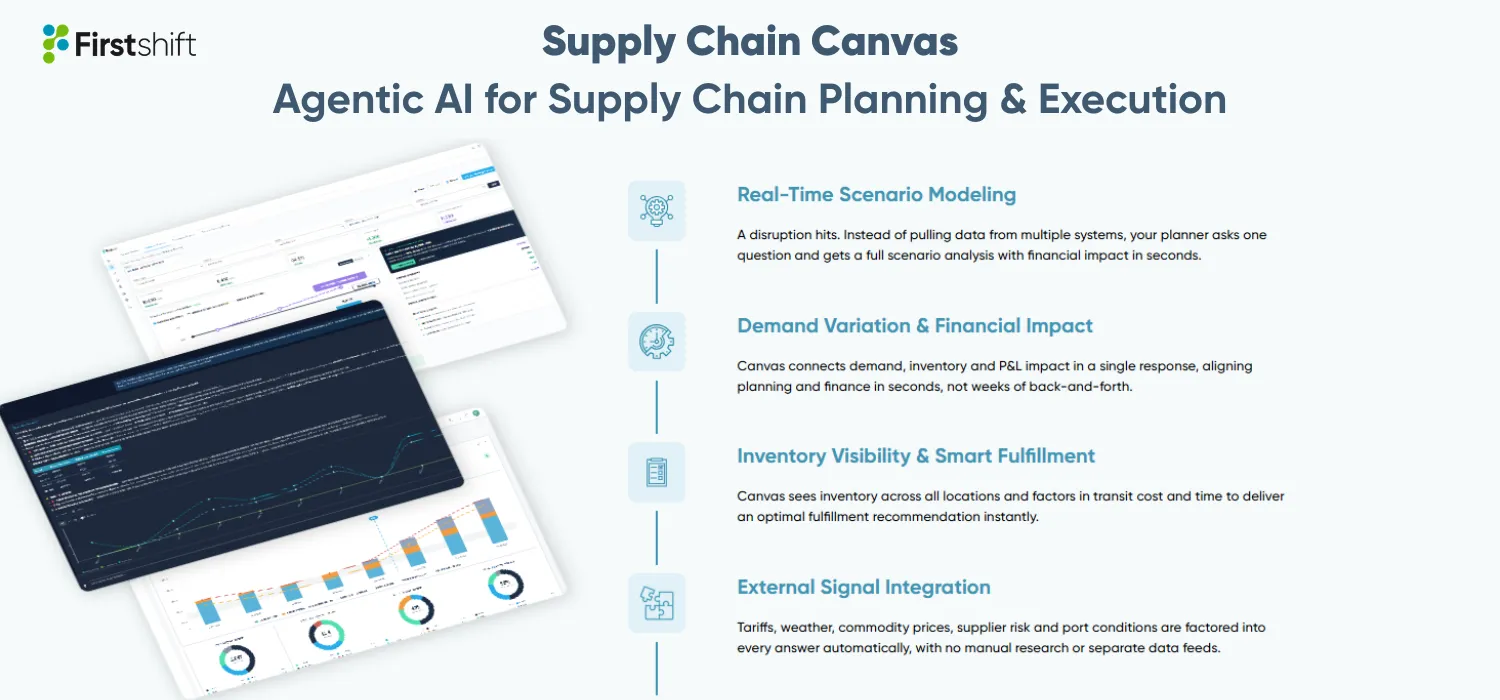
Real-time scenario planning. A disruption hits: a supplier delay, a port shutdown, a demand spike. Instead of pulling data from multiple systems and building an ad-hoc spreadsheet model, a planner asks Canvas one question and receives a full scenario analysis with financial impact in seconds. This is the kind of speed that PwC's survey identified as critical: the ability to move from insight to action before conditions shift again.
Demand variation and financial impact. When demand changes, quantifying the P&L impact typically requires a separate process with finance involving different systems, different timelines and different assumptions. Canvas connects demand, inventory and financial impact in a single response, aligning planning and finance in seconds instead of weeks.
Inventory visibility and smart fulfillment. A planner needs to find the best fulfillment path for a potential stockout. Canvas sees inventory across all locations and factors in transit cost and time to deliver an optimal recommendation, work that previously required cross-referencing multiple systems and manual analysis.
External signal integration. Tariffs, weather, commodity prices, supplier risk and port conditions are factored into every Canvas response automatically. In a year where the NFTC's 2025 Supply Chain Survey found that 94% of respondents reported tariff-driven disruptions to raw material procurement, this kind of built-in external intelligence moves from nice-to-have to essential.
What Does This Mean for the Role of the Supply Chain Planner?
Canvas gives planners the decision intelligence and ability to make faster, better decisions.
Today, the typical planner spends roughly 80% of their time on data gathering, spreadsheet modeling, stakeholder follow-up and report formatting. Just 5% goes to strategic decision-making. Canvas inverts that ratio: by automating the data-to-action pipeline, planners focus on exception management, cross-functional alignment, demand shaping and S&OP leadership.
The impact is immediate. With Canvas handling the routine data work, planners spend their time where it matters most: analyzing exceptions, collaborating with sales and finance, shaping demand and leading S&OP conversations with confidence. Each planner can take on more SKUs, more customers and more scenarios because they're operating at a strategic level instead of assembling spreadsheets. And because Canvas requires zero training, the shift happens from day one.
As Hari Menon, CEO of Firstshift, put it: "Canvas gives planners the ability to make faster decisions. It makes them the strategists they were hired to be. The goal is to enable more scenario analysis and better decisions at a faster pace than traditionally possible."
How Do You Get Started With Supply Chain Canvas?
For companies already on the Firstshift platform, Canvas can go live in as little as two weeks with zero additional data migration. The deployment process is straightforward:
Week 1 covers setup and configuration: connecting Canvas to existing Firstshift data, configuring the semantic model for the organization's hierarchy, validating data mapping and completing security review.
Week 2 involves piloting with two to three planners on real scenarios, fine-tuning responses, briefing the broader team and going live.
Whether you're running a legacy planning system or a rigid enterprise platform, Supply Chain Canvas layers seamlessly on top, delivering the same agentic AI capability without disrupting existing infrastructure.
Supply Chain Canvas is SOC-2 Type 2 and GDPR compliant, built by supply chain practitioners with deep domain expertise and backed by Firstshift's evergreen cloud-native platform with continuous, automatic upgrades.
Ready to see Supply Chain Canvas™ in action? Schedule a demo using your own data.
Ready to see Firstshift in action?
Request a personalised demo and see how Firstshift can transform your supply chain planning.