
Demand volatility is no longer an exception in Food and Beverage manufacturing. It is the operating environment.
For many Food and Beverage manufacturers, the challenge is not a lack of data or effort. It is that planning models built for stability are being pushed beyond their limits by volatility, complexity, and speed.
This scenario reflects a reality shared by many organizations facing the same constraints and decisions.
The Problem With ERP-Based Planning Under Volatility
This Food and Beverage manufacturer operated a national distribution network with multiple plants and a growing SKU portfolio. The business supported a mix of retail, wholesale, and promotional demand, each with its own volatility profile.
The ERP was deeply embedded and mission-critical. It handled transactions, execution, and financials reliably. But it was never designed to sense rapid demand shifts or support continuous planning adjustments.
To compensate, planners relied on spreadsheets layered on top of ERP data. Over time, those spreadsheets became increasingly complex, fragile, and dependent on individual expertise.
Under stable conditions, the system worked. Under volatility, it broke.
Why Food & Beverage Volatility Breaks Spreadsheet Planning
Volatility exposed structural weaknesses in the planning approach.
- Forecasts lagged real demand signals
- Inventory swung between excess and shortage
- Shelf-life risk increased write-offs
- Planners spent more time reconciling data than making decisions
The problem was not poor planning discipline. It was that spreadsheet-based planning could not scale decision velocity across SKUs, locations, and constraints.
ERP replacement was not an option. The cost, risk, and disruption were too high. Any improvement had to work with the existing system of record.
The Breaking Point: When Volatility Became a Business Risk
What triggered change was not a single failure, but cumulative exposure.
Forecast misses became financially visible. Inventory write-offs increased. Service levels suffered during promotional spikes. Leadership began asking how quickly the organization could respond when assumptions changed.
The mandate was clear: Improve planning decisions quickly, without destabilizing core systems or redesigning the business.
How Manufacturers Manage Demand Volatility Without Replacing ERP
Rather than replacing systems, the company focused on changing how decisions were made.
Planning Intelligence Layered on Top of ERP
The ERP remained the system of record. A planning intelligence layer sat above it, ingesting data and continuously sensing demand changes.
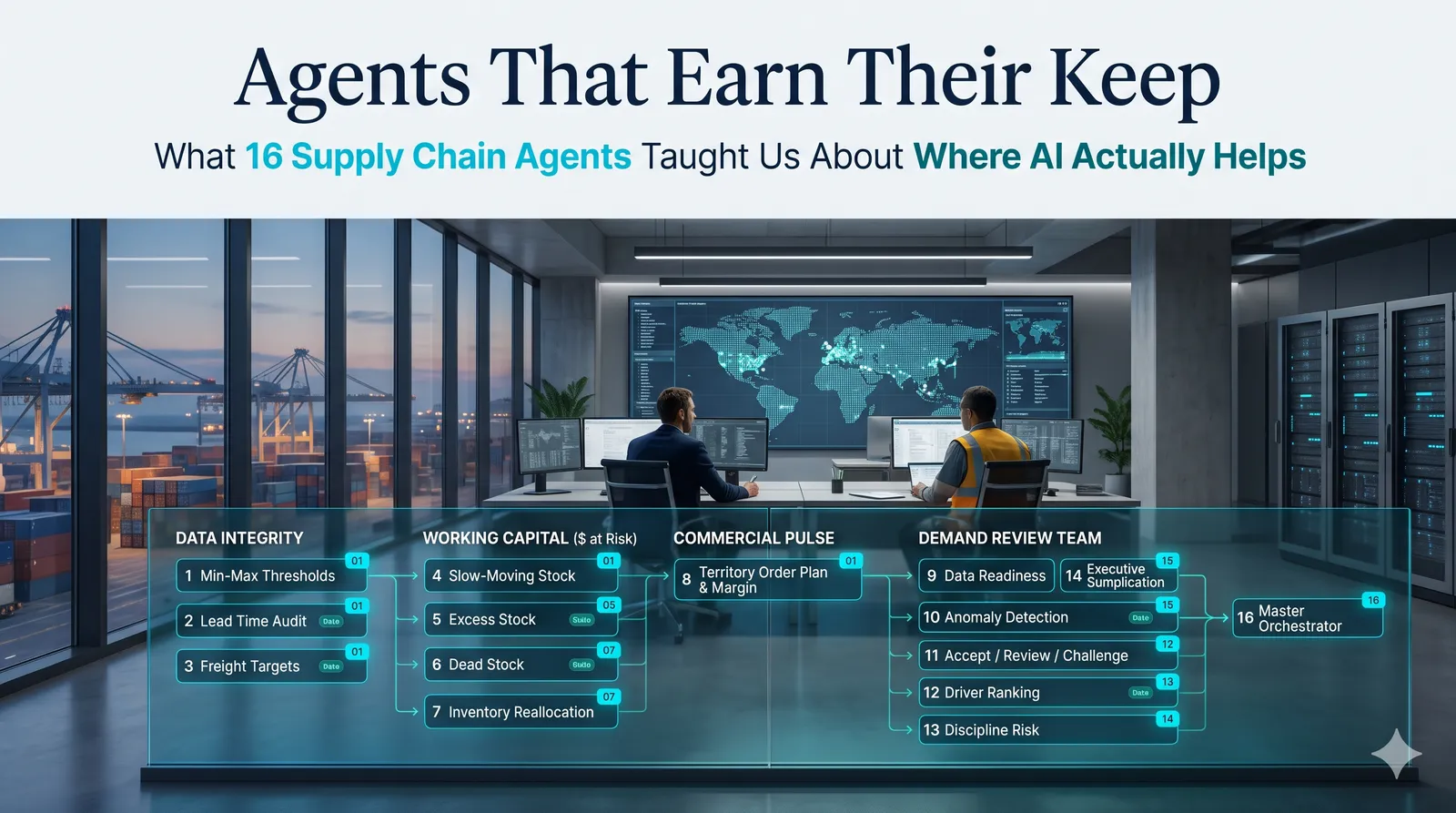
AI-driven demand sensing surfaced shifts earlier. Inventory and replenishment logic reflected real-world constraints such as shelf-life, capacity, and lead times. Scenario modeling allowed planners to test responses before committing inventory or production.
This approach respected existing processes while dramatically improving responsiveness.
Signals → Decisions → Outcomes
A practical framework for managing volatility
Signals
What the business saw sooner:
- Early demand shifts across channels and customers
- Promotion-driven volatility before inventory was committed
- Emerging shelf-life and imbalance risk
- Constraint pressure across plants and distribution
Volatility became visible earlier, not after execution.
Decisions
What planners acted on with confidence:
- Forecast adjustments grounded in real-time signals
- Inventory positioning decisions with clear tradeoffs
- Replenishment actions aligned to actual constraints
- Scenario-based responses tested before commitment
Decisions moved from reactive correction to proactive choice.
Outcomes
What the business experienced:
- Reduced inventory exposure and waste
- Improved service levels during volatile periods
- Faster planning cycles with fewer manual overrides
- Less dependence on individual spreadsheet expertise
Volatility shifted from constant fire drill to manageable operating condition.
Results of Faster Planning Decisions Under Volatility
Operational Impact
Within the first planning cycles, the manufacturer saw measurable improvements:
- Faster detection of demand changes
- More stable inventory levels despite volatility
- Shorter planning cycles
- Fewer last-minute execution changes
Decisions that once took days of reconciliation were made in hours.
Organizational Impact
Confidence improved across the organization. Planners trusted the signals they were seeing. Leadership gained visibility into risk without micromanaging execution. Institutional knowledge became embedded into workflows rather than trapped in individual heroics.
Why This Matters for Food & Beverage Manufacturers
Volatility is not the core problem. Slow, fragile decision-making is.
For many Food and Beverage manufacturers, ERP replacement is unrealistic. Spreadsheet-driven planning does not scale. The opportunity lies in modernizing planning intelligence without disrupting execution systems.
ERP executes transactions. Planning intelligence connects signals to decisions to outcomes.
Solved
Schedule a discovery call to see how real-world planning problems that manufacturers face every day can be addressed without replacing the systems that keep the business running.
Ready to see Firstshift in action?
Request a personalised demo and see how Firstshift can transform your supply chain planning.